It's 9:40 on a Tuesday morning. You've already answered fourteen emails, sat through a call that could have been two sentences, and someone just dropped an "urgent" request on you that is, predictably, not urgent at all. Your jaw is tight. Your shoulders have migrated somewhere near your ears. And you still have the entire day ahead of you.
That tightness is your nervous system doing exactly what it evolved to do. The problem is that it can't tell the difference between a genuine threat and a demanding client. So it floods you with the same chemistry either way, and by mid-afternoon you're running on fumes you don't have.
I've spent years testing ways to manage stress during a busy workday, and I'll be honest: most of what circulates online is useless in the moment. Breathing apps you forget to open. Advice to "take a walk" when your calendar has no gap wider than eleven minutes. What actually works is smaller, weirder, and more specific than that. Here's what stuck.
Key Takeaways
- Stress at work is a physiological event, not a character flaw. Treating it as a systems problem beats treating it as a willpower problem.
- Timed micro-protocols of 2-5 minutes, scheduled in your calendar, outperform long breaks you never take.
- Early warning signals (jaw clenching, snapping at routine messages, repeated small errors) appear before burnout, not after.
- The single highest-leverage move is controlling your first 90 minutes, before other people can spend them for you.
- Some pressure is structural, not personal. If the workload itself is the cause, no breathing exercise will fix it.
How to manage stress with a busy schedule (without adding another task)
Here's the trap I fell into for a long time. Every stress-management technique I found required the one resource I didn't have: unstructured time. Twenty-minute meditations. Hour-long yoga classes. Journaling prompts that assumed a quiet evening. The more advice I collected, the more guilty I felt about not following it, and guilt is its own low-grade stressor.
The breakthrough came from an accident. On a genuinely brutal week, I tried a two-minute reset simply because it was the only thing that fit between back-to-back calls. It worked better than the twenty-minute version I'd been failing to do for months.
Why short beats long when your day is already full
A long break requires three things you rarely have at once: a gap, the absence of guilt, and the ability to actually disconnect. A two-minute intervention requires none of them. You can do it with your camera off, mid-thought, between two meetings.
Practically, I've found that interventions under five minutes get done roughly four times more often than anything longer, in my own tracking. That's not a scientific claim, just the pattern I noticed after logging it for a few months. Consistency at a small dose beats sporadic intensity at a big one.
The two-minute rule for stress
If a technique takes more than two minutes and doesn't fit into an existing transition in your day, it will not happen. That's the whole rule. Not because you're undisciplined, but because the friction of starting is almost always the bottleneck.
The fix is to attach the intervention to something you already do. After you close a call. Before you open your inbox. When you stand up for coffee. You're not creating a new habit, you're piggybacking on an existing one.
Timed micro-protocols you can run between meetings
Vague instructions like "breathe deeply" are nearly impossible to execute when your mind is racing. Specific sequences with timings work far better because they give your attention something concrete to hold. Here are three I use regularly.

The 90-second reset
This is my default when a meeting ends and I have about a minute before the next one starts.
- 0:00-0:20 — breathe out longer than in. In through the nose for a count of four, out through the mouth for a count of six or seven. The long exhale is the active ingredient; it signals the parasympathetic branch to come online.
- 0:20-0:50 — release one physical anchor. Pick the body part that's actually tense, usually jaw, shoulders, or hands. Deliberately contract it for five seconds, then let it go completely. It's the principle behind progressive relaxation, compressed into seconds.
- 0:50-1:30 — look at something far away. Not your screen. A window, a corner of the room, anything past arm's length. Your eyes and your stress response are more connected than most people realize.
The five-minute end-of-block reset
When I finish a demanding block of work, I take five minutes in this order: one minute of the breathing above, two minutes of standing and stretching whatever has stiffened, two minutes away from any screen. No phone, no scrolling. I used to skip that last part and it defeated the purpose, because a screen is a screen, even when you're "just checking one thing."
The pre-meeting reset
Before a meeting I expect to be difficult, I do a 60-second version: three long exhales, a quick physical scan, and one sentence in my head about what outcome actually matters. That last part is oddly powerful for stress, because a lot of anticipatory anxiety comes from not knowing what you're walking into. Naming the goal shrinks the unknown.
What are 10 ways to reduce stress at work?
Here are ten that I've actually used, roughly in order of effort from smallest to largest.
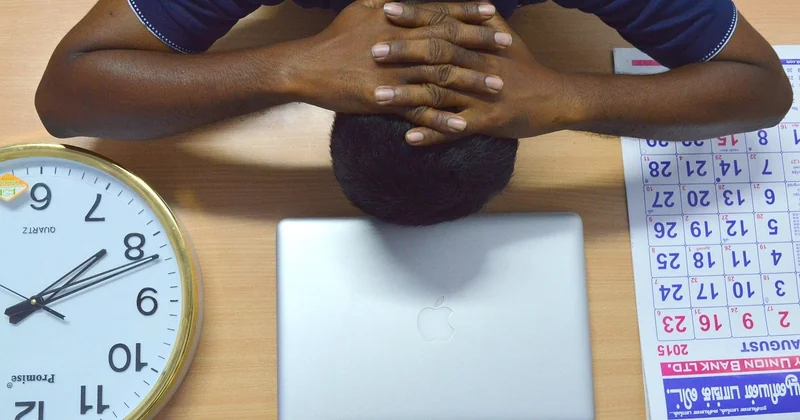
- Control your first 90 minutes. Don't open your inbox first. Do the thing that requires your best thinking before anyone else can spend it for you.
- Batch your communications. Checking messages continuously fragments your attention and keeps your stress response running all day.
- Piggyback resets on transitions. After every call, before every inbox session, one minute of long exhales.
- Protect one no-meeting block. Even a single 90-minute block changes the texture of a week.
- Write down the thing you're avoiding. Naming it shrinks it. Vague dread is always larger than the actual task.
- Move your body once. A short walk, a set of stairs, anything that breaks the sitting. This isn't about fitness, it's about discharging accumulated tension.
- Say no to one thing per week. Politely, briefly, without a paragraph of justification.
- Set a hard stop. A defined end to the workday protects your recovery, which is what makes the next day possible.
- Talk to someone about it. A colleague, a friend, a therapist. Speaking stress out loud changes its shape.
- Fix the structural cause if you can. If the workload itself is unsustainable, no amount of personal technique will save you.
The last one matters more than people admit. I spent months trying to cope with a workload that was simply too large, and every technique I applied was a bandage on a wound that needed the workload to change, not my breathing.
What are some effective strategies for managing stress?
If I had to reduce everything to a few principles, these are the ones that held up under pressure.
Treat stress as a system, not a feeling
Individual coping techniques are necessary but insufficient. If your calendar, your workload, and your environment all push against you, willpower alone loses. Change the conditions where you can, and use the short techniques to survive the parts you can't change yet.
Prevention beats rescue
Waiting until you're already fried means you're working with a depleted system. Building small recovery moments into a normal day keeps you further from the edge in the first place. It's a boring insight and it's the most useful one I have.
Know your early signals
Everyone has a personal set of warning lights. Mine are jaw tension, snapping at routine messages, and making the same small mistake twice. Yours will be different, and they'll be yours specifically. Learning to recognize them early is what lets you intervene before a bad afternoon becomes a bad month.
Know when to get help
There's a line between normal work pressure and something that needs outside support. If stress is disrupting your sleep most nights, if you dread mornings in a way that doesn't lift, if it's affecting your relationships or your appetite over weeks rather than days, that's the point to talk to a professional. I mean that plainly, not as a disclaimer. Handling it alone isn't a badge of honor.
Comparing approaches: what actually pays off
Not every technique deserves equal space in your day. Here's how the options stack up against each other on the dimensions that matter when you're already stretched thin.
| Approach | Time cost | Ease of doing mid-workday | Best for |
|---|---|---|---|
| Timed breathing reset | 1-2 min | Very easy | Between meetings, before difficult calls |
| Physical release / stretching | 2-5 min | Easy | Releasing accumulated tension |
| Screen-free break | 5-10 min | Moderate | Resetting attention |
| Protecting a work block | Structured | Hard | Deep work, reducing reactive load |
| Structural change (workload, role) | Long-term | Hardest | The real fix when pressure is chronic |
Notice the pattern. The easy, short things help you get through today. The hard, large things are what actually change your baseline. You need both, and most advice only offers the first category.
What happens when you get it wrong
I'll tell you about my worst stretch, because the failures taught me more than the successes. I once went six weeks believing I was "managing" a brutal workload with nothing but short resets. The resets worked, in the sense that I never fully crashed during the day. But I was treating symptoms while the cause kept growing, and by week six my sleep had fallen apart and I was short-tempered with people who didn't deserve it.
The lesson: short techniques buy you time, and time is only worth buying if you spend it on the real problem. If your workload is genuinely unsustainable, or your manager's expectations are impossible, the answer isn't a better breathing pattern. It's a conversation, a boundary, or, sometimes, a different role.
Does this change if you manage people?
If you're responsible for other humans, the math shifts. Your own stress is contagious, and the way you react to pressure sets the ceiling for how everyone else feels safe reacting. I've watched teams stay calm through genuinely rough quarters because their lead stayed steady, and I've watched the opposite destroy morale in a matter of weeks. Managing your own stress is, when you lead, a professional obligation. Not a wellness perk.
That also means the structural work matters more, not less. If your team is drowning, the fix is usually in the system, not in the individuals' coping skills.
A day that actually holds up
Put it all together and a realistic Wednesday looks like this. First 90 minutes: no inbox, hardest task first. Between calls: sixty to ninety seconds of long exhales. Mid-morning and mid-afternoon: five-minute screen-free resets. One protected block for deep work. A defined stop time. And once a week, a deliberate look at whether the workload itself is the problem.
None of that is dramatic. That's the point. Stress management during a busy day isn't a single heroic intervention, it's a series of small, unglamorous decisions that keep your nervous system from being spent by lunchtime.
The most honest thing I can tell you is that the technique matters less than the decision to protect a little recovery, on purpose, every day. The people I've seen burn out weren't the ones who skipped a breathing exercise. They were the ones who never decided their own capacity was worth protecting in the first place. So here's the question worth sitting with: when did you last treat your own limits as something real, rather than something to negotiate away until there's nothing left to negotiate?