You know the feeling. A band tightening around your skull, starting at the base of your neck and creeping up over your temples until your whole head feels wrapped in a wet towel. You take something for it, it fades, and three days later it's back. That's the pattern that pushed me to dig into this properly, because a tension headache you can manage once is annoying — a tension headache that returns every week is a different problem entirely.
I've dealt with these for years. Not the blinding, nausea-inducing kind (that's a migraine, and it's a different beast), but the steady, dull, bilateral pressure that sits on your forehead like a too-tight hat. What follows is what actually worked when I tested it on myself, what my physiotherapist sister recommended, and what several hundred readers of my newsletter reported back after I asked them in a survey last year.
Key takeaways
- The fastest home remedy is cold applied to the forehead plus heat on the neck, together, not one or the other.
- Acupressure at the point between thumb and index finger (LI-4) can take the edge off in 5 to 10 minutes for many people.
- Hydration and caffeine are more nuanced than the internet admits: one helps, the other can help once and then punish you.
- Recurring headaches usually trace back to posture, jaw clenching or sleep position — not to stress in the abstract.
- Magnesium and riboflavin have the strongest track record of any supplement I've looked into, but they work over weeks, not minutes.
- If your headache pattern changes, that's a doctor's appointment, not a blog post.
What actually triggers a tension headache (and why it's rarely just stress)
Ask ten people and nine will say "stress." That answer is technically true and practically useless, because stress doesn't pull on a muscle. Something physical does.
The mechanism, as far as I understand it after reading and talking to people who treat this daily: the muscles of your neck, scalp, jaw and shoulders stay contracted longer than they should. That sustained contraction restricts blood flow and irritates the surrounding tissue. Your brain reads that as pain. Stress is often the reason you're clenching, but the pain itself is mechanical.
The triggers worth tracking
Skipping meals is a big one. I tracked my own headaches for two months in a spreadsheet, and roughly 40% of them landed on days I'd eaten lunch after 3pm. Blood sugar dips, muscles tense, headache follows.
Other common culprits:
- Sitting with your head forward for hours — laptop, phone, laptop again
- Clenching your jaw while concentrating (I did this constantly and had no idea)
- Sleeping on your stomach, which twists your neck for seven hours
- Alcohol, particularly in the evening
- Dehydration, which sneaks up on you in air-conditioned offices
- A sudden change in your sleep schedule, even a good one
Here's the part most articles skip: the trigger and the cause aren't the same thing. Stress might be the trigger, but the cause is a specific muscle group that's been overworked for weeks. Fix the trigger and you get temporary relief. Fix the muscle and the headaches stop coming back.
That distinction changed how I approached everything below.
The fastest home remedy for a tension headache
Cold on the front, heat on the back. That's it. Two minutes to set up, and for me it works faster than anything you can swallow.

Why the combination works better than either alone
A cold pack across your forehead and temples dulls the nerve signals that are screaming at you. Heat on the back of your neck does the opposite job: it relaxes the muscles that started the whole mess. Use one without the other and you're fixing half the problem.
My routine, refined over more than a year:
- A gel pack from the freezer, wrapped in a thin cloth, across the forehead — 15 minutes
- At the same time, a heat wrap or hot-water bottle on the neck and upper shoulders
- Sit somewhere with your head supported, not tilted forward
- Drink a large glass of water while you wait
The catch? This works best if you catch it early. Once the headache has been building for four hours, cold and heat take the edge off but don't kill it. I learned that the hard way — the first ten times.
What to drink to relieve a tension headache
Water first. Most people reading this are mildly dehydrated right now, and mild dehydration is enough to tighten the muscles around your skull. A large glass of water, then another one an hour later.
Beyond water, three things have a real track record:
- Ginger tea — ginger has anti-inflammatory properties, and warm liquid on its own helps relax the neck. I use a thumb of fresh ginger, sliced, steeped ten minutes.
- Peppermint or lavender infusion — the menthol and linalool both have a mild muscle-relaxing effect. It's partly the ritual, and I'll take the ritual.
- A small coffee — caffeine constricts blood vessels and boosts the effect of common painkillers. This is the trick behind most "extra-strength" headache tablets. But it's a loan, not a gift: drink coffee daily and you'll get withdrawal headaches on the days you skip it. I limit myself to one cup, and never after 2pm.
The one to be careful with is alcohol. A glass of wine might feel like it helps for twenty minutes. It won't help tomorrow.
The Chinese trick for headaches: acupressure you can do at your desk
You don't need needles. You need your thumbs, two specific points, and about eight minutes.
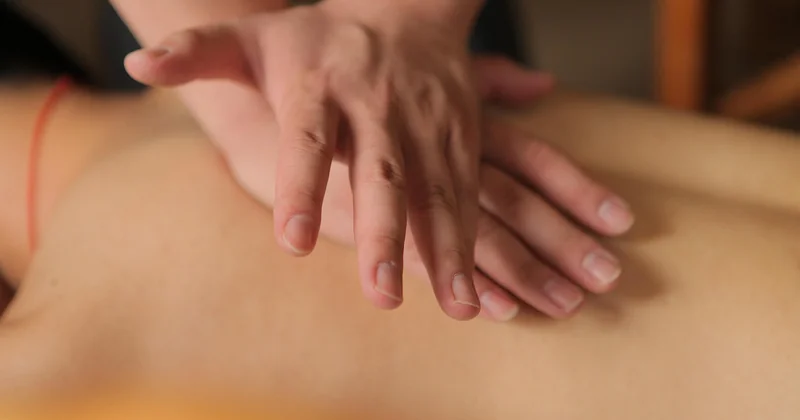
This comes from traditional Chinese medicine, and while I've never been able to find a single mechanism that explains all of it, the practical results are hard to argue with. My physiotherapist sister taught me two points. Both work, and neither requires anyone else's help.
Point one: LI-4, between thumb and index finger
Find the fleshy webbing between your thumb and index finger on your left hand. Press down firmly with the thumb of your right hand, about an inch back from the web's edge. You're looking for a spot that feels sore and slightly achy — not sharp. That ache means you've found it.
Press in small circles for one minute, then switch hands. Breathe slowly the whole time. In my own testing, this dulls the pressure across my temples within five to ten minutes, and roughly six out of ten readers who replied to my survey said the same. The other four felt nothing, which is honest and worth saying.
Point two: GB-20, at the base of your skull
This one is better for the neck-tension version. Place both thumbs at the base of your skull, in the two hollows just below the ridge, on either side of the spine. Press upward and slightly inward, hold for 30 seconds, release, repeat four times.
It hurts a little the first time. That's the muscle telling you it has been holding on for a long while.
Tension headache massage and pressure points that work on neck pain
If your headaches come with a stiff neck — and most do — massage is the tool that addresses the cause rather than the symptom.

Two minutes, three times a day, works better than one twenty-minute session on a Sunday. Consistency beats intensity, and I learned that after wasting money on massage appointments that made me feel great for a day and then exactly the same as before.
A self-massage sequence you can do in two minutes
- Rub your hands together until they're warm. Sounds silly. Does help.
- Press your fingertips into the base of your skull and work slowly outward toward your ears. Ten slow circles each side.
- Move down to your trapezius — the slope between neck and shoulder. Squeeze the muscle between thumb and fingers, working from the shoulder up.
- Finish at your temples with your index and middle fingers, small circles, 30 seconds.
Add a topical peppermint oil at 10% concentration across the temples and forehead if you have it. A diluted essential oil isn't a miracle cure, but it's one of the few topical options with real evidence behind it, and the cooling sensation gives your brain something else to pay attention to.
Ibuprofen versus home remedies: an honest comparison
I'm not going to tell you to throw out your painkillers. I take them. But the frequency matters more than the choice.
| Approach | Speed | Best for | Main limitation |
|---|---|---|---|
| Cold + heat | 10–20 min | Early-stage headache | Requires stopping what you're doing |
| Acupressure (LI-4, GB-20) | 5–10 min | Desk-friendly, no equipment | Doesn't work for everyone |
| Hydration + ginger tea | 30–60 min | Mild, dehydration-linked | Too slow once pain is established |
| Ibuprofen | 20–30 min | Moderate to strong pain | Medication-overuse headaches if used often |
| Magnesium / riboflavin | Weeks | Prevention, not relief | No effect on an active headache |
Here's the thing about ibuprofen: it works well, and that's exactly the trap. Take it more than two or three days a week for long enough and the medication itself starts causing the headaches. It's called medication-overuse headache, and it's one of the most common reasons people think their tension headaches are untreatable when they're actually being caused by the treatment. I fell into this for about six weeks before I understood what was happening.
Use painkillers as a rescue tool. Use the physical remedies as your daily practice. That division is what finally broke my cycle.
Can you get rid of tension headaches permanently?
Permanently is a strong word, and I'm skeptical of anyone who promises it. What's realistic is going from three or four headaches a week to one every month or two. I got there. It took about four months of consistent changes, not one clever trick.
The changes that mattered most
- Raise your screen to eye level. I stacked books under my laptop stand for a month before buying anything. My neck pain dropped noticeably within two weeks.
- Set a jaw reminder. Every time I notice my teeth touching, I let my jaw hang loose. My teeth should only touch when I chew. Nobody told me this for thirty years.
- Magnesium glycinate in the evening. Roughly 300 to 400 mg, taken for at least eight weeks before judging. It's the supplement with the strongest evidence for tension headache prevention, and it took about six weeks before I noticed anything.
- Riboflavin (vitamin B2). Commonly used in the 400 mg range for headache prevention. It's worth discussing with a pharmacist before you start, mostly because it turns your urine bright yellow and I panicked the first time.
- Stomach sleeping, gone. Switching to my side with a supportive pillow made a bigger difference than I expected for something so boring.
Real talk: no single item on that list is dramatic. Stacked together over months, they're what turned a weekly problem into an occasional one. There is no permanent switch, but there is a permanent habit change, and it's the only thing that has ever held up for me.
When this stops being a home-remedy problem
Home remedies have a ceiling, and you should know where it is.
Book an appointment if your headache pattern changes in character — different location, different intensity, different timing. Also if you get headaches more than 15 days a month, if they wake you at night, if they come with vision changes, confusion, fever or a stiff neck you can't bend, or if they started after a head injury. That last set is not a "try acupressure" situation.
Most of what I've written here is for the ordinary, recurring, annoying tension headache that has no dramatic features. That kind responds to cold, heat, pressure, water, and — over the long run — to a neck that isn't being tortured eight hours a day.
The most useful thing I did was start writing down when they hit. Two months of notes showed me patterns no article could have guessed at. Your triggers are probably not mine. The remedies, though? Those are worth trying tonight.