Simple breathing exercises to reduce anxiety: what actually works when your chest tightens
Your heart is hammering, your thoughts are sprinting, and someone tells you to "just breathe." If you have ever wanted to punch that person, you are in good company. I certainly did, the first time a well-meaning friend said it to me during a panic episode on a train platform in Lyon.
Here is the strange part: they were right. Not about the delivery, obviously. But about the mechanism. Breathing is one of the very few involuntary functions you can hijack on purpose, and when you do it correctly, you can pull your nervous system out of a spiral in under two minutes. The catch is that most people, including me for years, do it wrong.
This is not a listicle of ten techniques you will forget by Thursday. It is what I actually use, what I have watched work on other people, and what the physiology genuinely supports. Some of it is unglamorous. Some of it takes practice you will resent at first. All of it is free and available in your body right now.
Key takeaways
- Slow, extended exhales are the active ingredient. A longer out-breath than in-breath is what flips the switch.
- Around five minutes a day of a simple technique beats a heroic half-hour session once a month.
- The 4-7-8 pattern is one option among several, not a magic formula. Some people hate it, and that is fine.
- If you are mid-panic, counting breaths is often impossible. A physical anchor like the 3-3-3 rule works better first.
- You cannot think your way out of a sympathetic nervous system spike. You have to breathe or move your way out.
- Consistency over intensity. Three weeks of daily short sessions changed more for me than any single long session ever did.
Why breathing calms anxiety at all
The link between anxiety and breathing runs in both directions, and that is the whole trick. Anxiety makes you breathe fast and shallow, from the upper chest. Fast shallow breathing tells your brain there is a threat, so it keeps the alarm on. You have created a loop, and the loop runs by itself.
You can break it from the breathing side. Slow, diaphragmatic breathing engages the parasympathetic nervous system, the branch responsible for rest and digestion. Your heart rate drops, blood pressure settles, and the mental churn loses some of its fuel.
The exhale does the work, not the inhale
Here is what took me an embarrassingly long time to understand. Inhaling is mildly activating. Exhaling is where the calming happens, especially when the out-breath is longer than the in-breath. Your heart rate naturally speeds up slightly on the inhale and slows on the exhale, a phenomenon called respiratory sinus arrhythmia.
So the goal of nearly every anti-anxiety breathing pattern is the same: make the exhale longer and smoother than the inhale. Once you see that, the dozens of named techniques collapse into one principle with cosmetic variations.
Which brings up an obvious problem. If the principle is that simple, why does it fail so often?
Why it often fails
Because people try to breathe deeply while already panicking, force it, get dizzy, and conclude breathing exercises do not work for them. I did exactly this for two years. I would take giant gulps of air, feel lightheaded, and decide the whole thing was nonsense.
Two mistakes cause most of these failures. First, breathing too hard rather than too slowly. Depth is not the goal; length is. Second, holding your breath until you are uncomfortable. Retention should feel like a pause, never like a countdown you are surviving. Fix those two things and the technique starts behaving.
The breathing exercises worth your time
You do not need a library of techniques. You need two or three you can run without thinking, because in the middle of an anxiety spike you will not be able to follow a complex protocol. Here is what I keep in rotation.
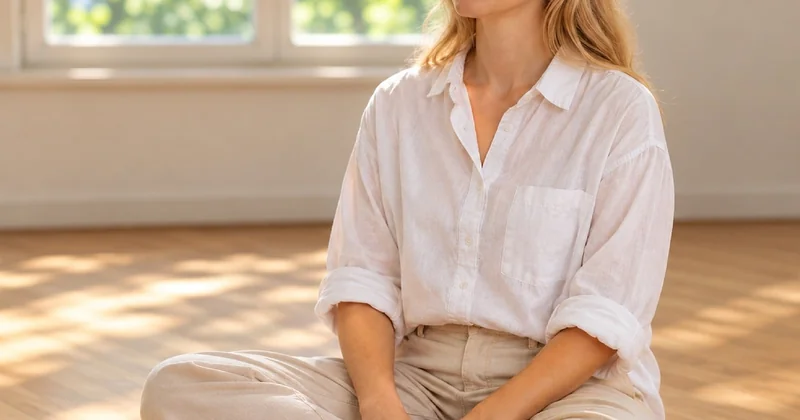
The extended exhale (start here)
Inhale through your nose for a count of four. Exhale through your mouth, slowly, for a count of six to eight. No retention. Repeat for one to two minutes. That is it.
This is my default, and honestly I would defend it as the single best option for beginners. There is nothing to memorize, nothing to hold, and it is almost impossible to do badly. When my chest tightens before a presentation, this is the one I use. Roughly thirty seconds in, the tightness softens.
Box breathing (4-4-4-4)
Inhale for four, hold for four, exhale for four, hold for four. Four equal phases, hence the name. It is popular with people in high-stakes jobs for a simple reason: the structure gives your mind something to count, which crowds out the spiraling thoughts.
Fair warning. The equal phases mean the exhale is not longer, so the calming effect is gentler than the extended exhale. I use box breathing when I need focus, not when I need to come down from panic.
What is the 4-7-8 breathing technique?
Inhale through the nose for four seconds, hold for seven, exhale slowly through the mouth for eight. The long exhale is the point, and the retention builds a mild oxygen debt that makes the final release feel satisfying. I use 4-7-8 at night, lying in bed, because it reliably slows me down within about four cycles. In the daytime, though, the seven-second hold feels like an eternity, and I usually drop it for the plain extended exhale.
Do breathing exercises actually work for anxiety?
Yes, but with honest caveats. The strongest evidence points to slow breathing with prolonged exhalation as an effective way to lower acute physiological arousal. That means it reliably reduces heart rate, and it reliably interrupts the anxiety-breathing loop in the short term.
What it will not do is treat a clinical anxiety disorder on its own. A breathing pattern is a tool for a moment, not a replacement for therapy or medical care. If anxiety is running your life, breathing is part of the answer, and only part.
In my own case, the effect is cumulative. A single session gives me maybe a ten to twenty percent reduction in that clenched feeling. Doing it daily for three weeks flattened the baseline noticeably. The daily practice did more than any one dramatic session, which is the opposite of how I expected it to work.
What is the 3-3-3 rule for anxiety?
The 3-3-3 rule is a grounding technique, not a breathing one. When anxiety hits, you name three things you can see, three sounds you can hear, and then move three parts of your body—a foot, a hand, a shoulder. The count forces your attention onto your immediate surroundings instead of the loop in your head.
I reach for this when breathing fails, which happens more often than the internet admits. Mid-panic, counting breaths can feel impossible, because counting is exactly what a hijacked mind cannot do. Naming three objects in the room is easier. It is concrete. And moving three body parts gets you out of your head and into the physical room you are actually standing in.
My routine is layered. If I catch the anxiety early, I breathe. If it has already arrived, I ground first with 3-3-3 and breathe once the edge comes off.
How to calm the sympathetic nervous system
The sympathetic nervous system is the accelerator. When it fires, your body diverts resources toward a threat: faster heart, quicker breath, tense muscles, digestion on hold. You cannot talk it down with a pep talk, because it does not process language the way you wish it did. You influence it through physical signals, and breathing is the fastest one available.
Signals that actually reach the body
- Slow the exhale. The single most direct lever you have.
- Cool your face. Splashing cold water triggers the dive reflex, which slows the heart rate.
- Hum or chant. The vibration and the long out-breath work together.
- Move. A short walk burns off some of the mobilized energy the accelerator produced.
- Relax your jaw and drop your shoulders; tension there feeds the alarm.
None of these are exotic, and that is the point. They send the body a physical message—not a verbal one—that the threat has passed. Repeated often enough, the message lands.
What are some natural remedies for anxiety?
Breathing is the fastest and the most portable, but it is not alone. The remedies that hold up best in real life are the unglamorous ones, and they compound when stacked together.

| Remedy | How fast it works | Best for |
|---|---|---|
| Extended exhale breathing | Seconds | Acute spikes, pre-event nerves |
| 3-3-3 grounding | Seconds | Mid-panic, when counting is too hard |
| Cold water on the face | Instant | Overwhelmed moments |
| Regular movement | Days to weeks | Lowering the baseline over time |
| Consistent sleep | Weeks | Reducing overall reactivity |
The table is honest about timing, and that matters. Breathing tools manage the moment. Movement and sleep change the baseline, so you have fewer moments to manage. When I neglect sleep for a week, my breathing exercises do measurably less. I have stopped pretending those are separate problems.
Putting it together so it sticks
Pick one thing: the extended exhale, five minutes a day, same time each day. Not when you are anxious, because in that state you will not remember the technique. Train it while calm, so it becomes the reflex your body reaches for when the spike arrives.
I keep a small card on my desk with two lines on it: breathe out longer than you breathe in, and if that fails, name three things you see. That is the entire system. After months of tinkering, the elaborate version I started with collapsed into those two lines, and it works better than the elaborate version ever did.
How long until breathing exercises work?
For the acute effect, seconds to a couple of minutes. For a change in your everyday baseline, give it two to three weeks of daily practice. The catch is that it has to be daily, not sporadic. A few good sessions a month will not move the needle.
What if I feel dizzy or short of breath?
You are almost certainly breathing too hard or too fast. Shrink the inhale, keep the exhale long and loose, and stop if it persists. Dizziness means you are pushing, not relaxing, and pushing defeats the whole purpose.
The next time someone tells you to breathe, do not roll your eyes. The advice was correct even if the delivery was clumsy. Just make sure you exhale longer than you inhale, and give it a few weeks before you decide it does not work for you.