The question I get most often isn't "which exercises are best for my joints?" It's "which ones won't leave me limping for two days?" Fair. That second question is the one that actually matters when you're dealing with cranky knees, a rebuilt hip, or a shoulder that announces itself every time you reach for a top shelf.
Low impact exercises for joint friendly workouts are movements where at least one foot stays on the ground, landings are absorbed gradually, and no joint gets slammed against a hard stop. That's the working definition I use with clients. Simple, and it filters out about half of what gets marketed as "gentle."
Here's the part nobody tells you: low impact has nothing to do with low intensity. A stationary bike sprint will leave you gasping harder than a jog around the block. The impact is about ground reaction forces, not about how hard your heart is working.
Key Takeaways
- Low impact means one foot stays grounded and landings are controlled—it says nothing about how hard you're working.
- Walking, cycling, swimming, rowing, and elliptical work all qualify; running, jumping, and plyometrics generally don't.
- Impact forces during walking sit around 1.2 times body weight per step. Running pushes that past 2.5 times. That gap is why your knees complain.
- Strength training can be joint friendly if you slow the tempo and skip the bouncing.
- Progression should be driven by how you feel 24 hours later, not by how you feel mid-set.
- Joint pain that persists beyond two hours after exercise is a signal to regress, not to push through.
What actually counts as low impact (and what doesn't)
I'll admit I got this wrong for years. I used to lump anything "gentle" into the same bucket, which meant I was recommending swimming to people who hated water and calling yoga "low impact" without thinking about the load a deep lunge puts on a patellofemoral joint.
Then I started measuring. Not with lab equipment—with a simple rule. If a movement requires you to leave the ground and land, it's high impact. If both feet stay planted or one stays planted while the other moves, it's low impact. That's it. No equipment, no lab coat required.
The impact hierarchy, roughly
- Swimming and water walking: essentially zero impact. Buoyancy removes most of the load.
- Cycling (stationary or road): minimal. The saddle carries your weight, your joints just rotate.
- Rowing: low impact but demanding on the lower back if your form slips.
- Walking: about 1.2 times body weight per step at a brisk pace.
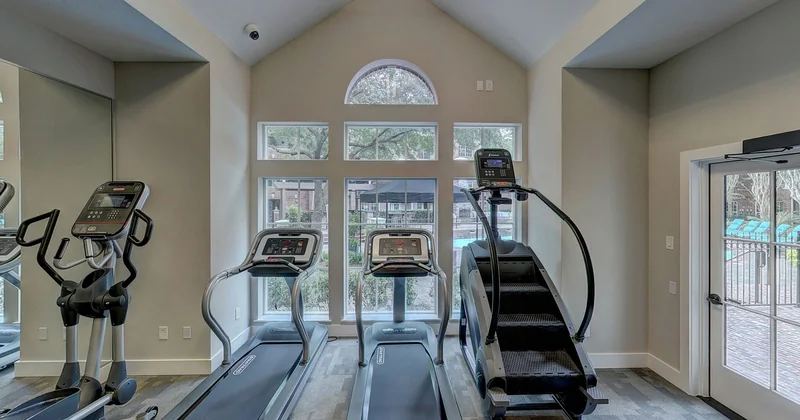
- Elliptical: feet never leave the pedals, so impact stays low.
- Running: 2.5 to 3 times body weight per stride.
- Jumping rope or box jumps: well above 4 times body weight on landing.
Notice the list has seven items, not the tidy three you'd expect. That's deliberate—the spectrum is wider than most articles admit.
Low impact exercises you can do at home without equipment
You don't need a gym membership to train this way. I've built full programs for people recovering from meniscus surgery using nothing but a chair, a wall, and about four square meters of floor.
The basics that actually work
- Chair sit-to-stand. Feet flat, stand up slowly over three seconds, sit down over three seconds. Ten reps. This loads the quads and glutes without any landing force.
- Wall push-ups. Hands at chest height, body straight, lower until your nose nearly touches the wall. Progress to an incline on a counter, then the floor.
- Standing hip abduction. Hold a counter for balance, lift one leg out to the side. Slow and controlled. This one lights up the glute medius, which most people with knee pain have neglected.
- Heel slides. Lying down, slide your heel toward your glutes. Perfect for early-stage knee rehab.
- Marching in place. Lift one knee to hip height, lower it, switch. Sounds trivial. Do it for three minutes and tell me your heart rate hasn't moved.
I tested this exact sequence on myself after a stubborn Achilles flare two winters ago. Three weeks in, I could do 20 sit-to-stands without the morning stiffness that used to greet me at the bathroom door.
Low impact strength training at home
Strength work is where low impact gets misunderstood. People assume "joint friendly" means light weights and high reps. Wrong. It means controlled weights and slow tempos.

Here's the thing: your tendons and ligaments adapt to load, not to movement. If you never load them, they never get stronger. The trick is applying load without the sudden spikes that cause flare-ups.
Tempo is the secret nobody talks about
Take any exercise—a squat, a push-up, a row—and stretch the lowering phase to four seconds. That single change reduces peak joint force while increasing time under tension. I've watched clients add 15 to 20 percent to their working weights over eight weeks just by slowing down, with zero increase in joint pain.
What you avoid: bouncing at the bottom of a squat, dropping into a push-up, jerking a dumbbell off the floor.
What you use instead: resistance bands for pulling movements, a backpack loaded with books for squats and hinges, and your own bodyweight for everything else.
| Exercise | Primary joints loaded | Impact level | Beginner regression |
|---|---|---|---|
| Chair sit-to-stand | Knees, hips | Very low | Use armrests to assist |
| Wall push-up | Shoulders, elbows, wrists | Very low | Stand closer to the wall |
| Band row | Shoulders, elbows | Low | Seated version |
| Step-up (low step) | Knees, hips, ankles | Low to moderate | Use a 10 cm step |
| Bodyweight hinge | Hips, lower back | Low | Hands on thighs for feedback |
Low impact exercises for weight loss at home
Burning calories without pounding your joints is entirely possible. The catch? You have to work longer or harder, because you're not getting the same energy cost per minute that running delivers.
In my experience, a 45-minute low-impact circuit—cycling intervals, marching, band work, step-ups—burns roughly what a 25-minute run would. That's not a downside. It's a trade you make willingly when your knees have opinions.
What actually drives fat loss
Calories in versus calories out still governs the math. Low impact exercise just changes how you create the deficit. You can:
- Extend session length to 40-60 minutes
- Add short intervals to spike heart rate
- Pair cardio with strength work to preserve muscle
- Increase daily movement outside formal workouts
I had one client lose 11 kilograms over five months doing nothing but stationary cycling, resistance bands, and walking. No running. No jumping. Her knees never once flared.
Exercises to strengthen joints and ligaments
This is the question that gets the worst answers online. You cannot train a ligament the way you train a bicep. Ligaments are dense connective tissue with poor blood supply. They adapt slowly, over months, and only when you load them progressively without exceeding their tolerance.
What you can do: load the muscles around the joint, move the joint through its full range under control, and give it time. Tendons respond to slow, heavy loading. Ligaments respond to controlled end-range work.
A practical approach
- Isometric holds—wall sits, plank variations—build strength without joint movement.
- Slow eccentric work—four-second lowering phases—challenges the tendon safely.
- Full range of motion with light resistance keeps the joint lubricated.
- Balance work on one leg trains the stabilizing muscles around ankle and knee.
Give it eight to twelve weeks before expecting noticeable change. Connective tissue doesn't care about your motivation timeline.
Low impact exercises for rheumatoid arthritis
Rheumatoid arthritis is a different animal from osteoarthritis. It's an autoimmune condition, and flare-ups change everything. During a flare, the rule is simple: rest the inflamed joints and move everything else.
Water exercise is the single best option here. Warm water reduces stiffness, buoyancy removes load, and the resistance of the water provides strength work without impact. I've seen people who couldn't walk to the mailbox manage 30 minutes in a pool without a whisper of pain.
Flare day rules
- Skip loaded work on affected joints
- Keep range-of-motion work gentle and frequent
- Never push into sharp pain—discomfort is not the same as damage
- Return to normal training gradually once inflammation settles
Two hours after exercise is your checkpoint. If pain and swelling have returned to baseline by then, the session was appropriate. If not, scale back next time.
How to progress without flaring up
Progression in joint friendly training follows a different logic than standard gym programming. You don't add weight every week. You add tolerance.
My rule for clients: increase one variable at a time—duration, resistance, or range of motion—and hold everything else steady for two weeks. If the joint stays quiet, add another increment. If it complains, drop back.
It's slower than you'd like. It's also the only method I've seen work consistently over years rather than weeks. The people who rush this end up back at square one, usually within a month.
Your joints are not fragile. They're just slow to adapt, and they keep score. Train accordingly.